📄 playwright-python/dotnet/docs/release-notes
File: release-notes.md | Updated: 11/18/2025
Source: https://playwright.dev/dotnet/docs/release-notes
On this page
Version 1.55
Codegen
- Automatic
ToBeVisibleAsync()assertions: Codegen can now generate automaticToBeVisibleAsync()assertions for common UI interactions. This feature can be enabled in the Codegen settings UI.
Breaking Changes
- ⚠️ Dropped support for Chromium extension manifest v2.
Miscellaneous
-
Added support for Debian 13 "Trixie".
-
Added support for Xunit v3 as part of
Microsoft.Playwright.Xunit.v3 -
Added support for MSTest v4 as part of
Microsoft.Playwright.MSTest.v4
Browser Versions
- Chromium 140.0.7339.16
- Mozilla Firefox 141.0
- WebKit 26.0
This version was also tested against the following stable channels:
- Google Chrome 139
- Microsoft Edge 139
Version 1.54
Highlights
-
New cookie property
PartitionKeyin BrowserContext.CookiesAsync() and BrowserContext.AddCookiesAsync() . This property allows to save and restore partitioned cookies. See CHIPS MDN article for more information. Note that browsers have different support and defaults for cookie partitioning. -
New option
--user-data-dirin multiple commands. You can specify the same user data dir to reuse browsing state, like authentication, between sessions.pwsh bin/Debug/netX/playwright.ps1 codegen --user-data-dir=./user-data -
pwsh bin/Debug/netX/playwright.ps1 opendoes not open the test recorder anymore. Usepwsh bin/Debug/netX/playwright.ps1 codegeninstead.
Browser Versions
- Chromium 139.0.7258.5
- Mozilla Firefox 140.0.2
- WebKit 26.0
This version was also tested against the following stable channels:
- Google Chrome 140
- Microsoft Edge 140
Version 1.53
Trace Viewer and HTML Reporter Updates
-
New Steps in Trace Viewer:
-
New method Locator.Describe() to describe a locator. Used for trace viewer.
var button = Page.GetByTestId("btn-sub").Describe("Subscribe button");await button.ClickAsync(); -
pwsh bin/Debug/netX/playwright.ps1 install --listwill now list all installed browsers, versions and locations.
Browser Versions
- Chromium 138.0.7204.4
- Mozilla Firefox 139.0
- WebKit 18.5
This version was also tested against the following stable channels:
- Google Chrome 137
- Microsoft Edge 137
Version 1.52
Highlights
-
New method Expect(Locator).ToContainClassAsync() to ergonomically assert individual class names on the element.
await Expect(Page.GetByRole(AriaRole.Listitem, new() { Name = "Ship v1.52" })).ToContainClassAsync("done"); -
Aria Snapshots got two new properties:
/childrenfor strict matching and/urlfor links.await Expect(locator).ToMatchAriaSnapshotAsync(@" - list - /children: equal - listitem: Feature A - listitem: - link ""Feature B"": - /url: ""https://playwright.dev""");
Miscellaneous
- New option MaxRedirects in ApiRequest.NewContextAsync() to control the maximum number of redirects.
Breaking Changes
- Glob URL patterns in methods like Page.RouteAsync()
do not support
?and[]anymore. We recommend using regular expressions instead. - Method Route.ContinueAsync()
does not allow to override the
Cookieheader anymore. If aCookieheader is provided, it will be ignored, and the cookie will be loaded from the browser's cookie store. To set custom cookies, use BrowserContext.AddCookiesAsync() . - macOS 13 is now deprecated and will no longer receive WebKit updates. Please upgrade to a more recent macOS version to continue benefiting from the latest WebKit improvements.
Browser Versions
- Chromium 136.0.7103.25
- Mozilla Firefox 137.0
- WebKit 18.4
This version was also tested against the following stable channels:
- Google Chrome 135
- Microsoft Edge 135
Version 1.51
Highlights
-
New option IndexedDB for BrowserContext.StorageStateAsync() allows to save and restore IndexedDB contents. Useful when your application uses IndexedDB API to store authentication tokens, like Firebase Authentication.
Here is an example following the authentication guide :
// Save storage state into the file. Make sure to include IndexedDB.await context.StorageStateAsync(new(){ Path = "../../../playwright/.auth/state.json", IndexedDB = true});// Create a new context with the saved storage state.var context = await browser.NewContextAsync(new(){ StorageStatePath = "../../../playwright/.auth/state.json"}); -
New option Visible for Locator.Filter() allows matching only visible elements.
// Ignore invisible todo items.var todoItems = Page.GetByTestId("todo-item").Filter(new() { Visible = true });// Check there are exactly 3 visible ones.await Expect(todoItems).ToHaveCountAsync(3); -
New option
Contrastfor methods Page.EmulateMediaAsync() and Browser.NewContextAsync() allows to emulate theprefers-contrastmedia feature. -
New option FailOnStatusCode makes all fetch requests made through the APIRequestContext throw on response codes other than 2xx and 3xx.
Browser Versions
- Chromium 134.0.6998.35
- Mozilla Firefox 135.0
- WebKit 18.4
This version was also tested against the following stable channels:
- Google Chrome 133
- Microsoft Edge 133
Version 1.50
Support for Xunit
- Support for xUnit 2.8+ via Microsoft.Playwright.Xunit . Follow our Getting Started guide to learn more.
Miscellaneous
- Added method Expect(Locator).ToHaveAccessibleErrorMessageAsync() to assert the Locator points to an element with a given aria errormessage .
UI updates
- New button in Codegen for picking elements to produce aria snapshots.
- Additional details (such as keys pressed) are now displayed alongside action API calls in traces.
- Display of
canvascontent in traces is error-prone. Display is now disabled by default, and can be enabled via theDisplay canvas contentUI setting. CallandNetworkpanels now display additional time information.
Breaking
- Expect(Locator).ToBeEditableAsync()
and Locator.IsEditableAsync()
now throw if the target element is not
<input>,<select>, or a number of other editable elements.
Browser Versions
- Chromium 133.0.6943.16
- Mozilla Firefox 134.0
- WebKit 18.2
This version was also tested against the following stable channels:
- Google Chrome 132
- Microsoft Edge 132
Version 1.49
Aria snapshots
New assertion Expect(Locator).ToMatchAriaSnapshotAsync() verifies page structure by comparing to an expected accessibility tree, represented as YAML.
await page.GotoAsync("https://playwright.dev");await Expect(page.Locator("body")).ToMatchAriaSnapshotAsync(@" - banner: - heading /Playwright enables reliable/ [level=1] - link ""Get started"" - link ""Star microsoft/playwright on GitHub"" - main: - img ""Browsers (Chromium, Firefox, WebKit)"" - heading ""Any browser • Any platform • One API""");
You can generate this assertion with Test Generator or by calling Locator.AriaSnapshotAsync() .
Learn more in the aria snapshots guide .
Tracing groups
New method Tracing.GroupAsync() allows you to visually group actions in the trace viewer.
// All actions between GroupAsync and GroupEndAsync// will be shown in the trace viewer as a group.await Page.Context.Tracing.GroupAsync("Open Playwright.dev > API");await Page.GotoAsync("https://playwright.dev/");await Page.GetByRole(AriaRole.Link, new() { Name = "API" }).ClickAsync();await Page.Context.Tracing.GroupEndAsync();
Breaking: chrome and msedge channels switch to new headless mode
This change affects you if you're using one of the following channels in your playwright.config.ts:
chrome,chrome-dev,chrome-beta, orchrome-canarymsedge,msedge-dev,msedge-beta, ormsedge-canary
After updating to Playwright v1.49, run your test suite. If it still passes, you're good to go. If not, you will probably need to update your snapshots, and adapt some of your test code around PDF viewers and extensions. See issue #33566 for more details.
Try new Chromium headless
You can opt into the new headless mode by using 'chromium' channel. As official Chrome documentation puts it
:
New Headless on the other hand is the real Chrome browser, and is thus more authentic, reliable, and offers more features. This makes it more suitable for high-accuracy end-to-end web app testing or browser extension testing.
See issue #33566 for the list of possible breakages you could encounter and more details on Chromium headless. Please file an issue if you see any problems after opting in.
runsettings.xml
<?xml version="1.0" encoding="utf-8"?><RunSettings>  <Playwright>    <BrowserName>chromium</BrowserName>    <LaunchOptions>      <Channel>chromium</Channel>    </LaunchOptions>  </Playwright></RunSettings>

dotnet test -- Playwright.BrowserName=chromium Playwright.LaunchOptions.Channel=chromium
Miscellaneous
- There will be no more updates for WebKit on Ubuntu 20.04 and Debian 11. We recommend updating your OS to a later version.
<canvas>elements inside a snapshot now draw a preview.
Browser Versions
- Chromium 131.0.6778.33
- Mozilla Firefox 132.0
- WebKit 18.2
This version was also tested against the following stable channels:
- Google Chrome 130
- Microsoft Edge 130
Version 1.48
WebSocket routing
New methods Page.RouteWebSocketAsync()
and BrowserContext.RouteWebSocketAsync()
allow to intercept, modify and mock WebSocket connections initiated in the page. Below is a simple example that mocks WebSocket communication by responding to a "request" with a "response".
await page.RouteWebSocketAsync("/ws", ws => { ws.OnMessage(frame => { if (frame.Text == "request") ws.Send("response"); });});
See WebSocketRoute for more details.
UI updates
- New "copy" buttons for annotations and test location in the HTML report.
- Route method calls like Route.FulfillAsync() are not shown in the report and trace viewer anymore. You can see which network requests were routed in the network tab instead.
- New "Copy as cURL" and "Copy as fetch" buttons for requests in the network tab.
Miscellaneous
- New method Page.RequestGCAsync() may help detect memory leaks.
- Requests made by APIRequestContext now record detailed timing and security information in the HAR.
Browser Versions
- Chromium 130.0.6723.19
- Mozilla Firefox 130.0
- WebKit 18.0
This version was also tested against the following stable channels:
- Google Chrome 129
- Microsoft Edge 129
Version 1.47
Network Tab improvements
The Network tab in the trace viewer has several nice improvements:
- filtering by asset type and URL
- better display of query string parameters
- preview of font assets
Miscellaneous
- The
mcr.microsoft.com/playwright/dotnet:v1.47.0now serves a Playwright image based on Ubuntu 24.04 Noble. To use the 22.04 jammy-based image, please usemcr.microsoft.com/playwright/dotnet:v1.47.0-jammyinstead. - The
:latest/:focal/:jammytag for Playwright Docker images is no longer being published. Pin to a specific version for better stability and reproducibility. - TLS client certificates can now be passed from memory by passing ClientCertificates.Cert and ClientCertificates.Key as byte arrays instead of file paths.
- NoWaitAfter in Locator.SelectOptionAsync() was deprecated.
- We've seen reports of WebGL in Webkit misbehaving on GitHub Actions
macos-13. We recommend upgrading GitHub Actions tomacos-14.
Browser Versions
- Chromium 129.0.6668.29
- Mozilla Firefox 130.0
- WebKit 18.0
This version was also tested against the following stable channels:
- Google Chrome 128
- Microsoft Edge 128
Version 1.46
TLS Client Certificates
Playwright now allows to supply client-side certificates, so that server can verify them, as specified by TLS Client Authentication.
You can provide client certificates as a parameter of Browser.NewContextAsync()
and ApiRequest.NewContextAsync()
. The following snippet sets up a client certificate for https://example.com:
var context = await Browser.NewContextAsync(new() { ClientCertificates = [ new() { Origin = "https://example.com", CertPath = "client-certificates/cert.pem", KeyPath = "client-certificates/key.pem", } ]});
Trace Viewer Updates
- Content of text attachments is now rendered inline in the attachments pane.
- New setting to show/hide routing actions like Route.ContinueAsync() .
- Request method and status are shown in the network details tab.
- New button to copy source file location to clipboard.
- Metadata pane now displays the
BaseURL.
Miscellaneous
- New
maxRetriesoption in ApiRequestContext.FetchAsync() which retries on theECONNRESETnetwork error.
Browser Versions
- Chromium 128.0.6613.18
- Mozilla Firefox 128.0
- WebKit 18.0
This version was also tested against the following stable channels:
- Google Chrome 127
- Microsoft Edge 127
Version 1.45
Clock
Utilizing the new Clock API allows to manipulate and control time within tests to verify time-related behavior. This API covers many common scenarios, including:
-
testing with predefined time;
-
keeping consistent time and timers;
-
monitoring inactivity;
-
ticking through time manually.
// Initialize clock with some time before the test time and let the page load naturally.//
Date.nowwill progress as the timers fire.await Page.Clock.InstallAsync(new(){ TimeDate = new DateTime(2024, 2, 2, 8, 0, 0)});await Page.GotoAsync("http://localhost:3333");// Pretend that the user closed the laptop lid and opened it again at 10am.// Pause the time once reached that point.await Page.Clock.PauseAtAsync(new DateTime(2024, 2, 2, 10, 0, 0));// Assert the page state.await Expect(Page.GetByTestId("current-time")).ToHaveTextAsync("2/2/2024, 10:00:00 AM");// Close the laptop lid again and open it at 10:30am.await Page.Clock.FastForwardAsync("30:00");await Expect(Page.GetByTestId("current-time")).ToHaveTextAsync("2/2/2024, 10:30:00 AM");
See the clock guide for more details.
Miscellaneous
-
Method Locator.SetInputFilesAsync() now supports uploading a directory for
<input type=file webkitdirectory>elements.await page.GetByLabel("Upload directory").SetInputFilesAsync("mydir"); -
Multiple methods like Locator.ClickAsync() or Locator.PressAsync() now support a
ControlOrMetamodifier key. This key maps toMetaon macOS and maps toControlon Windows and Linux.// Press the common keyboard shortcut Control+S or Meta+S to trigger a "Save" operation.await page.Keyboard.PressAsync("ControlOrMeta+S"); -
New property
httpCredentials.sendin ApiRequest.NewContextAsync() that allows to either always send theAuthorizationheader or only send it in response to401 Unauthorized. -
Playwright now supports Chromium, Firefox and WebKit on Ubuntu 24.04.
-
v1.45 is the last release to receive WebKit update for macOS 12 Monterey. Please update macOS to keep using the latest WebKit.
Browser Versions
- Chromium 127.0.6533.5
- Mozilla Firefox 127.0
- WebKit 17.4
This version was also tested against the following stable channels:
- Google Chrome 126
- Microsoft Edge 126
Version 1.44
New APIs
Accessibility assertions
-
Expect(Locator).ToHaveAccessibleNameAsync() checks if the element has the specified accessible name:
var locator = Page.GetByRole(AriaRole.Button);await Expect(locator).ToHaveAccessibleNameAsync("Submit"); -
Expect(Locator).ToHaveAccessibleDescriptionAsync() checks if the element has the specified accessible description:
var locator = Page.GetByRole(AriaRole.Button);await Expect(locator).ToHaveAccessibleDescriptionAsync("Upload a photo"); -
Expect(Locator).ToHaveRoleAsync() checks if the element has the specified ARIA role:
var locator = Page.GetByTestId("save-button");await Expect(locator).ToHaveRoleAsync(AriaRole.Button);
Locator handler
-
After executing the handler added with Page.AddLocatorHandlerAsync() , Playwright will now wait until the overlay that triggered the handler is not visible anymore. You can opt-out of this behavior with the new
NoWaitAfteroption. -
You can use new
Timesoption in Page.AddLocatorHandlerAsync() to specify maximum number of times the handler should be run. -
The handler in Page.AddLocatorHandlerAsync() now accepts the locator as argument.
-
New Page.RemoveLocatorHandlerAsync() method for removing previously added locator handlers.
var locator = Page.GetByText("This interstitial covers the button");await Page.AddLocatorHandlerAsync(locator, async (overlay) =>{ await overlay.Locator("#close").ClickAsync();}, new() { Times = 3, NoWaitAfter = true });// Run your tests that can be interrupted by the overlay.// ...await Page.RemoveLocatorHandlerAsync(locator);
Miscellaneous options
-
New method FormData.Append() allows to specify repeating fields with the same name in
Multipartoption inAPIRequestContext.FetchAsync():var formData = Context.APIRequest.CreateFormData();formData.Append("file", new FilePayload(){ Name = "f1.js", MimeType = "text/javascript", Buffer = System.Text.Encoding.UTF8.GetBytes("var x = 2024;")});formData.Append("file", new FilePayload(){ Name = "f2.txt", MimeType = "text/plain", Buffer = System.Text.Encoding.UTF8.GetBytes("hello")});var response = await Context.APIRequest.PostAsync("https://example.com/uploadFiles", new() { Multipart = formData }); -
Expect(Page).ToHaveURLAsync() now supports
IgnoreCaseoption .
Browser Versions
- Chromium 125.0.6422.14
- Mozilla Firefox 125.0.1
- WebKit 17.4
This version was also tested against the following stable channels:
- Google Chrome 124
- Microsoft Edge 124
Version 1.43
New APIs
-
Method BrowserContext.ClearCookiesAsync() now supports filters to remove only some cookies.
// Clear all cookies.await Context.ClearCookiesAsync();// New: clear cookies with a particular name.await Context.ClearCookiesAsync(new() { Name = "session-id" });// New: clear cookies for a particular domain.await Context.ClearCookiesAsync(new() { Domain = "my-origin.com" }); -
New property Locator.ContentFrame converts a Locator object to a FrameLocator . This can be useful when you have a Locator object obtained somewhere, and later on would like to interact with the content inside the frame.
var locator = Page.Locator("iframe[name='embedded']");// ...var frameLocator = locator.ContentFrame;await frameLocator.GetByRole(AriaRole.Button).ClickAsync(); -
New property FrameLocator.Owner converts a FrameLocator object to a Locator . This can be useful when you have a FrameLocator object obtained somewhere, and later on would like to interact with the
iframeelement.var frameLocator = page.FrameLocator("iframe[name='embedded']");// ...var locator = frameLocator.Owner;await Expect(locator).ToBeVisibleAsync();
Browser Versions
- Chromium 124.0.6367.8
- Mozilla Firefox 124.0
- WebKit 17.4
This version was also tested against the following stable channels:
- Google Chrome 123
- Microsoft Edge 123
Version 1.42
New Locator Handler
New method Page.AddLocatorHandlerAsync() registers a callback that will be invoked when specified element becomes visible and may block Playwright actions. The callback can get rid of the overlay. Here is an example that closes a cookie dialog when it appears.
// Setup the handler.await Page.AddLocatorHandlerAsync( Page.GetByRole(AriaRole.Heading, new() { Name = "Hej! You are in control of your cookies." }), async () => { await Page.GetByRole(AriaRole.Button, new() { Name = "Accept all" }).ClickAsync(); });// Write the test as usual.await Page.GotoAsync("https://www.ikea.com/");await Page.GetByRole(AriaRole.Link, new() { Name = "Collection of blue and white" }).ClickAsync();await Expect(Page.GetByRole(AriaRole.Heading, new() { Name = "Light and easy" })).ToBeVisibleAsync();
New APIs
- Page.PdfAsync() accepts two new options Tagged and Outline .
Announcements
- ⚠️ Ubuntu 18 is not supported anymore.
Browser Versions
- Chromium 123.0.6312.4
- Mozilla Firefox 123.0
- WebKit 17.4
This version was also tested against the following stable channels:
- Google Chrome 122
- Microsoft Edge 123
Version 1.41
New APIs
- New method Page.UnrouteAllAsync() removes all routes registered by Page.RouteAsync() and Page.RouteFromHARAsync() . Optionally allows to wait for ongoing routes to finish, or ignore any errors from them.
- New method BrowserContext.UnrouteAllAsync() removes all routes registered by BrowserContext.RouteAsync() and BrowserContext.RouteFromHARAsync() . Optionally allows to wait for ongoing routes to finish, or ignore any errors from them.
- New options Style in Page.ScreenshotAsync() and Style in Locator.ScreenshotAsync() to add custom CSS to the page before taking a screenshot.
Browser Versions
- Chromium 121.0.6167.57
- Mozilla Firefox 121.0
- WebKit 17.4
This version was also tested against the following stable channels:
- Google Chrome 120
- Microsoft Edge 120
Version 1.40
Test Generator Update
New tools to generate assertions:
- "Assert visibility" tool generates Expect(Locator).ToBeVisibleAsync() .
- "Assert value" tool generates Expect(Locator).ToHaveValueAsync() .
- "Assert text" tool generates Expect(Locator).ToContainTextAsync() .
Here is an example of a generated test with assertions:
await Page.GotoAsync("https://playwright.dev/");await Page.GetByRole(AriaRole.Link, new() { Name = "Get started" }).ClickAsync();await Expect(Page.GetByLabel("Breadcrumbs").GetByRole(AriaRole.List)).ToContainTextAsync("Installation");await Expect(Page.GetByLabel("Search")).ToBeVisibleAsync();await Page.GetByLabel("Search").ClickAsync();await Page.GetByPlaceholder("Search docs").FillAsync("locator");await Expect(Page.GetByPlaceholder("Search docs")).ToHaveValueAsync("locator");
New APIs
- Options Reason in Page.CloseAsync() , Reason in BrowserContext.CloseAsync() and Reason in Browser.CloseAsync() . Close reason is reported for all operations interrupted by the closure.
- Option FirefoxUserPrefs in BrowserType.LaunchPersistentContextAsync() .
Other Changes
- Methods Download.PathAsync() and Download.CreateReadStreamAsync() throw an error for failed and cancelled downloads.
- Playwright docker image now comes with .NET 8 (new LTS).
Browser Versions
- Chromium 120.0.6099.28
- Mozilla Firefox 119.0
- WebKit 17.4
This version was also tested against the following stable channels:
- Google Chrome 119
- Microsoft Edge 119
Version 1.39
Evergreen browsers update.
Browser Versions
- Chromium 119.0.6045.9
- Mozilla Firefox 118.0.1
- WebKit 17.4
This version was also tested against the following stable channels:
- Google Chrome 118
- Microsoft Edge 118
Version 1.38
Trace Viewer Updates
- Zoom into time range.
- Network panel redesign.
New APIs
Deprecations
- The following methods were deprecated: Page.TypeAsync() , Frame.TypeAsync() , Locator.TypeAsync() and ElementHandle.TypeAsync() . Please use Locator.FillAsync() instead which is much faster. Use Locator.PressSequentiallyAsync() only if there is a special keyboard handling on the page, and you need to press keys one-by-one.
Browser Versions
- Chromium 117.0.5938.62
- Mozilla Firefox 117.0
- WebKit 17.0
This version was also tested against the following stable channels:
- Google Chrome 116
- Microsoft Edge 116
Version 1.37
📚 Debian 12 Bookworm Support
Playwright now supports Debian 12 Bookworm on both x86_64 and arm64 for Chromium, Firefox and WebKit. Let us know if you encounter any issues!
Linux support looks like this:
| | Ubuntu 20.04 | Ubuntu 22.04 | Debian 11 | Debian 12 | | --- | --- | --- | --- | --- | | Chromium | ✅ | ✅ | ✅ | ✅ | | WebKit | ✅ | ✅ | ✅ | ✅ | | Firefox | ✅ | ✅ | ✅ | ✅ |
Browser Versions
- Chromium 116.0.5845.82
- Mozilla Firefox 115.0
- WebKit 17.0
This version was also tested against the following stable channels:
- Google Chrome 115
- Microsoft Edge 115
Version 1.36
🏝️ Summer maintenance release.
Browser Versions
- Chromium 115.0.5790.75
- Mozilla Firefox 115.0
- WebKit 17.0
This version was also tested against the following stable channels:
- Google Chrome 114
- Microsoft Edge 114
Version 1.35
Highlights
-
New option
MaskColorfor methods Page.ScreenshotAsync() and Locator.ScreenshotAsync() to change default masking color. -
New
uninstallCLI command to uninstall browser binaries:$ pwsh bin/Debug/netX/playwright.ps1 uninstall # remove browsers installed by this installation$ pwsh bin/Debug/netX/playwright.ps1 uninstall --all # remove all ever-install Playwright browsers
Browser Versions
- Chromium 115.0.5790.13
- Mozilla Firefox 113.0
- WebKit 16.4
This version was also tested against the following stable channels:
- Google Chrome 114
- Microsoft Edge 114
Version 1.34
Highlights
-
New Locator.And() to create a locator that matches both locators.
var button = page.GetByRole(AriaRole.BUTTON).And(page.GetByTitle("Subscribe")); -
New events BrowserContext.Console and BrowserContext.Dialog to subscribe to any dialogs and console messages from any page from the given browser context. Use the new methods ConsoleMessage.Page and Dialog.Page to pin-point event source.
Browser Versions
- Chromium 114.0.5735.26
- Mozilla Firefox 113.0
- WebKit 16.4
This version was also tested against the following stable channels:
- Google Chrome 113
- Microsoft Edge 113
Version 1.33
Locators Update
-
Use Locator.Or() to create a locator that matches either of the two locators. Consider a scenario where you'd like to click on a "New email" button, but sometimes a security settings dialog shows up instead. In this case, you can wait for either a "New email" button, or a dialog and act accordingly:
var newEmail = Page.GetByRole(AriaRole.Button, new() { Name = "New email" });var dialog = Page.GetByText("Confirm security settings");await Expect(newEmail.Or(dialog)).ToBeVisibleAsync();if (await dialog.IsVisibleAsync()) await Page.GetByRole(AriaRole.Button, new() { Name = "Dismiss" }).ClickAsync();await newEmail.ClickAsync(); -
Use new options HasNot and HasNotText|HasNotTextRegex in Locator.Filter() to find elements that do not match certain conditions.
var rowLocator = Page.Locator("tr");await rowLocator .Filter(new() { HasNotText = "text in column 1" }) .Filter(new() { HasNot = Page.GetByRole(AriaRole.Button, new() { Name = "column 2 button" })}) .ScreenshotAsync(); -
Use new web-first assertion Expect(Locator).ToBeAttachedAsync() to ensure that the element is present in the page's DOM. Do not confuse with the Expect(Locator).ToBeVisibleAsync() that ensures that element is both attached & visible.
New APIs
-
New option HasNot in Locator.Filter()
-
New option HasNotText|HasNotTextRegex in Locator.Filter()
-
New option Timeout in Route.FetchAsync()
⚠️ Breaking change
- The
mcr.microsoft.com/playwright/dotnet:v1.33.0now serves a Playwright image based on Ubuntu Jammy. To use the focal-based image, please usemcr.microsoft.com/playwright/dotnet:v1.33.0-focalinstead.
Browser Versions
- Chromium 113.0.5672.53
- Mozilla Firefox 112.0
- WebKit 16.4
This version was also tested against the following stable channels:
- Google Chrome 112
- Microsoft Edge 112
Version 1.32
New APIs
- New options UpdateMode and UpdateContent in Page.RouteFromHARAsync() and BrowserContext.RouteFromHARAsync() .
- Chaining existing locator objects, see locator docs for details.
- New option Name in method Tracing.StartChunkAsync() .
Browser Versions
- Chromium 112.0.5615.29
- Mozilla Firefox 111.0
- WebKit 16.4
This version was also tested against the following stable channels:
- Google Chrome 111
- Microsoft Edge 111
Version 1.31
New APIs
-
New assertion Expect(Locator).ToBeInViewportAsync() ensures that locator points to an element that intersects viewport, according to the intersection observer API .
var locator = Page.GetByRole(AriaRole.Button);// Make sure at least some part of element intersects viewport.await Expect(locator).ToBeInViewportAsync();// Make sure element is fully outside of viewport.await Expect(locator).Not.ToBeInViewportAsync();// Make sure that at least half of the element intersects viewport.await Expect(locator).ToBeInViewportAsync(new() { Ratio = 0.5 }); -
New methods BrowserContext.NewCDPSessionAsync() and Browser.NewBrowserCDPSessionAsync() create a Chrome DevTools Protocol session for the page and browser respectively.
Miscellaneous
- DOM snapshots in trace viewer can be now opened in a separate window.
- New option MaxRedirects for method Route.FetchAsync() .
- Playwright now supports Debian 11 arm64.
- Official docker images now include Node 18 instead of Node 16.
Browser Versions
- Chromium 111.0.5563.19
- Mozilla Firefox 109.0
- WebKit 16.4
This version was also tested against the following stable channels:
- Google Chrome 110
- Microsoft Edge 110
Version 1.30
Browser Versions
- Chromium 110.0.5481.38
- Mozilla Firefox 108.0.2
- WebKit 16.4
This version was also tested against the following stable channels:
- Google Chrome 109
- Microsoft Edge 109
Version 1.29
New APIs
-
New method Route.FetchAsync() and new option
Jsonfor Route.FulfillAsync() :await Page.RouteAsync("**/api/settings", async route => { // Fetch original settings. var response = await route.FetchAsync(); // Force settings theme to a predefined value. var json = await response.JsonAsync<MyDataType>(); json.Theme = "Solarized"; // Fulfill with modified data. await route.FulfillAsync(new() { Json = json });}); -
New method Locator.AllAsync() to iterate over all matching elements:
// Check all checkboxes!var checkboxes = Page.GetByRole(AriaRole.Checkbox);foreach (var checkbox in await checkboxes.AllAsync()) await checkbox.CheckAsync(); -
Locator.SelectOptionAsync() matches now by value or label:
<select multiple>  <option value="red">Red</option>  <option value="green">Green</option>  <option value="blue">Blue</option></select>

await element.SelectOptionAsync("Red");
Browser Versions
- Chromium 109.0.5414.46
- Mozilla Firefox 107.0
- WebKit 16.4
This version was also tested against the following stable channels:
- Google Chrome 108
- Microsoft Edge 108
Version 1.28
Playwright Tools
- Live Locators in CodeGen. Generate a locator for any element on the page using "Explore" tool.

New APIs
Browser Versions
- Chromium 108.0.5359.29
- Mozilla Firefox 106.0
- WebKit 16.4
This version was also tested against the following stable channels:
- Google Chrome 107
- Microsoft Edge 107
Version 1.27
Locators
With these new APIs writing locators is a joy:
-
Page.GetByText() to locate by text content.
-
Page.GetByRole() to locate by ARIA role , ARIA attributes and accessible name .
-
Page.GetByLabel() to locate a form control by associated label's text.
-
Page.GetByTestId() to locate an element based on its
data-testidattribute (other attribute can be configured). -
Page.GetByPlaceholder() to locate an input by placeholder.
-
Page.GetByAltText() to locate an element, usually image, by its text alternative.
-
Page.GetByTitle() to locate an element by its title.
await page.GetByLabel("User Name").FillAsync("John");await page.GetByLabel("Password").FillAsync("secret-password");await page.GetByRole(AriaRole.Button, new() { NameString = "Sign in" }).ClickAsync();await Expect(Page.GetByText("Welcome, John!")).ToBeVisibleAsync();
All the same methods are also available on Locator , FrameLocator and Frame classes.
Other highlights
- As announced in v1.25, Ubuntu 18 will not be supported as of Dec 2022. In addition to that, there will be no WebKit updates on Ubuntu 18 starting from the next Playwright release.
Behavior Changes
-
Expect(Locator).ToHaveAttributeAsync() with an empty value does not match missing attribute anymore. For example, the following snippet will succeed when
buttondoes not have adisabledattribute.await Expect(Page.GetByRole(AriaRole.Button)).ToHaveAttributeAsync("disabled", "");
Browser Versions
- Chromium 107.0.5304.18
- Mozilla Firefox 105.0.1
- WebKit 16.0
This version was also tested against the following stable channels:
- Google Chrome 106
- Microsoft Edge 106
Version 1.26
Assertions
- New option
Enabledfor Expect(Locator).ToBeEnabledAsync() . - Expect(Locator).ToHaveTextAsync() now pierces open shadow roots.
- New option
Editablefor Expect(Locator).ToBeEditableAsync() . - New option
Visiblefor Expect(Locator).ToBeVisibleAsync() . - Expect(Response).ToBeOKAsync() is now available.
Other highlights
- New option
MaxRedirectsfor ApiRequestContext.GetAsync() and others to limit redirect count. - Codegen now supports MSTest and NUnit frameworks.
- ASP .NET is now supported.
Behavior Change
A bunch of Playwright APIs already support the WaitUntil: WaitUntilState.DOMContentLoaded option. For example:
await Page.GotoAsync("https://playwright.dev", new() { WaitUntil = WaitUntilState.DOMContentLoaded });
Prior to 1.26, this would wait for all iframes to fire the DOMContentLoaded event.
To align with web specification, the WaitUntilState.DOMContentLoaded value only waits for the target frame to fire the 'DOMContentLoaded' event. Use WaitUntil: WaitUntilState.Load to wait for all iframes.
Browser Versions
- Chromium 106.0.5249.30
- Mozilla Firefox 104.0
- WebKit 16.0
This version was also tested against the following stable channels:
- Google Chrome 105
- Microsoft Edge 105
Version 1.25
New .runsettings file support
Microsoft.Playwright.NUnit and Microsoft.Playwright.MSTest will now consider the .runsettings file and passed settings via the CLI when running end-to-end tests. See in the documentation
for a full list of supported settings.
The following does now work:
<?xml version="1.0" encoding="utf-8"?><RunSettings> <!-- Playwright --> <Playwright> <BrowserName>chromium</BrowserName> <ExpectTimeout>5000</ExpectTimeout> <LaunchOptions> <Headless>true</Headless> <Channel>msedge</Channel> </LaunchOptions> </Playwright> <!-- General run configuration --> <RunConfiguration> <EnvironmentVariables> <!-- For debugging selectors, it's recommend to set the following environment variable --> <DEBUG>pw:api</DEBUG> </EnvironmentVariables> </RunConfiguration></RunSettings>
Announcements
- 🪦 This is the last release with macOS 10.15 support (deprecated as of 1.21).
- ⚠️ Ubuntu 18 is now deprecated and will not be supported as of Dec 2022.
Browser Versions
- Chromium 105.0.5195.19
- Mozilla Firefox 103.0
- WebKit 16.0
This version was also tested against the following stable channels:
- Google Chrome 104
- Microsoft Edge 104
Version 1.24
🐂 Debian 11 Bullseye Support
Playwright now supports Debian 11 Bullseye on x86_64 for Chromium, Firefox and WebKit. Let us know if you encounter any issues!
Linux support looks like this:
| | Ubuntu 20.04 | Ubuntu 22.04 | Debian 11 | :--- | :---: | :---: | :---: | :---: | | Chromium | ✅ | ✅ | ✅ | | WebKit | ✅ | ✅ | ✅ | | Firefox | ✅ | ✅ | ✅ |
New introduction docs
We rewrote our Getting Started docs to be more end-to-end testing focused. Check them out on playwright.dev .
Version 1.23
API Testing
Playwright for .NET 1.23 introduces new API Testing that lets you send requests to the server directly from .NET! Now you can:
- test your server API
- prepare server side state before visiting the web application in a test
- validate server side post-conditions after running some actions in the browser
To do a request on behalf of Playwright's Page, use new Page.APIRequest API:
// Do a GET request on behalf of pagevar response = await Page.APIRequest.GetAsync("http://example.com/foo.json");Console.WriteLine(response.Status);Console.WriteLine(response.StatusText);Console.WriteLine(response.Ok);Console.WriteLine(response.Headers["Content-Type"]);Console.WriteLine(await response.TextAsync());Console.WriteLine((await response.JsonAsync())?.GetProperty("foo").GetString());
Read more about it in our API testing guide .
Network Replay
Now you can record network traffic into a HAR file and re-use this traffic in your tests.
To record network into HAR file:
pwsh bin/Debug/netX/playwright.ps1 open --save-har=example.har --save-har-glob="**/api/**" https://example.com
Alternatively, you can record HAR programmatically:
var context = await browser.NewContextAsync(new(){ RecordHarPath = harPath, RecordHarUrlFilterString = "**/api/**",});// ... Perform actions ...// Close context to ensure HAR is saved to disk.context.CloseAsync();
Use the new methods Page.RouteFromHARAsync() or BrowserContext.RouteFromHARAsync() to serve matching responses from the HAR file:
await context.RouteFromHARAsync("example.har");
Read more in our documentation .
Advanced Routing
You can now use Route.FallbackAsync() to defer routing to other handlers.
Consider the following example:
// Remove a header from all requests.await page.RouteAsync("**/*", async route =>{ var headers = route.Request.Headers; headers.Remove("X-Secret"); await route.ContinueAsync(new() { Headers = headers });});// Abort all images.await page.RouteAsync("**/*", async route =>{ if (route.Request.ResourceType == "image") { await route.AbortAsync(); } else { await route.FallbackAsync(); }});
Note that the new methods Page.RouteFromHARAsync() and BrowserContext.RouteFromHARAsync() also participate in routing and could be deferred to.
Web-First Assertions Update
- New method Expect(Locator).ToHaveValuesAsync()
that asserts all selected values of
<select multiple>element. - Methods Expect(Locator).ToContainTextAsync()
and Expect(Locator).ToHaveTextAsync()
now accept
ignoreCaseoption.
Miscellaneous
-
If there's a service worker that's in your way, you can now easily disable it with a new context option
serviceWorkers:var context = await Browser.NewContextAsync(new(){ ServiceWorkers = ServiceWorkerPolicy.Block}); -
Using
.zippath forrecordHarcontext option automatically zips the resulting HAR:var context = await Browser.NewContextAsync(new() { RecordHarPath = "example.har.zip" }); -
If you intend to edit HAR by hand, consider using the
"minimal"HAR recording mode that only records information that is essential for replaying:var context = await Browser.NewContextAsync(new() { RecordHarPath = "example.har", RecordHarMode = HarMode.Minimal }); -
Playwright now runs on Ubuntu 22 amd64 and Ubuntu 22 arm64.
-
Playwright for .NET now supports linux-arm64 and provides a arm64 Ubuntu 20.04 Docker image for it.
Version 1.22
Highlights
-
Role selectors that allow selecting elements by their ARIA role , ARIA attributes and accessible name .
// Click a button with accessible name "log in"await page.Locator("role=button[name='log in']").ClickAsync();Read more in our documentation .
-
New Locator.Filter() API to filter an existing locator
var buttons = page.Locator("role=button");// ...var submitLocator = buttons.Filter(new() { HasText = "Sign up" });await submitLocator.ClickAsync();
Version 1.21
Highlights
-
New role selectors that allow selecting elements by their ARIA role , ARIA attributes and accessible name .
// Click a button with accessible name "log in"await page.Locator("role=button[name='log in']").ClickAsync();Read more in our documentation .
-
New
scaleoption in Page.ScreenshotAsync() for smaller sized screenshots. -
New
caretoption in Page.ScreenshotAsync() to control text caret. Defaults to"hide". -
We now ship a designated .NET docker image
mcr.microsoft.com/playwright/dotnet. Read more in our documentation .
Behavior Changes
- Playwright now supports large file uploads (100s of MBs) via Locator.SetInputFilesAsync() API.
Browser Versions
- Chromium 101.0.4951.26
- Mozilla Firefox 98.0.2
- WebKit 15.4
This version was also tested against the following stable channels:
- Google Chrome 100
- Microsoft Edge 100
Version 1.20
Web-First Assertions
Playwright for .NET 1.20 introduces Web-First Assertions .
Consider the following example:
using System.Threading.Tasks;using Microsoft.Playwright.NUnit;using NUnit.Framework;namespace PlaywrightTests;[TestFixture]public class ExampleTests : PageTest{ [Test] public async Task StatusBecomesSubmitted() { await Expect(Page.Locator(".status")).ToHaveTextAsync("Submitted"); }}
Playwright will be re-testing the node with the selector .status until fetched Node has the "Submitted" text. It will be re-fetching the node and checking it over and over, until the condition is met or until the timeout is reached. You can pass this timeout as an option.
Read more in our documentation .
Other Updates
- New options for methods Page.ScreenshotAsync()
, Locator.ScreenshotAsync()
and ElementHandle.ScreenshotAsync()
:
- Option
ScreenshotAnimations.Disabledrewinds all CSS animations and transitions to a consistent state - Option
mask: Locator[]masks given elements, overlaying them with pink#FF00FFboxes.
- Option
- Locator.HighlightAsync() visually reveals element(s) for easier debugging.
Announcements
- v1.20 is the last release to receive WebKit update for macOS 10.15 Catalina. Please update macOS to keep using latest & greatest WebKit!
Browser Versions
- Chromium 101.0.4921.0
- Mozilla Firefox 97.0.1
- WebKit 15.4
This version was also tested against the following stable channels:
- Google Chrome 99
- Microsoft Edge 99
Version 1.19
Highlights
-
Locator now supports a
hasoption that makes sure it contains another locator inside:await Page.Locator("article", new() { Has = Page.Locator(".highlight") }).ClickAsync();Read more in locator documentation
-
New Locator.Page
-
Page.ScreenshotAsync() and Locator.ScreenshotAsync() now automatically hide blinking caret
-
Playwright Codegen now generates locators and frame locators
Browser Versions
- Chromium 100.0.4863.0
- Mozilla Firefox 96.0.1
- WebKit 15.4
This version was also tested against the following stable channels:
- Google Chrome 98
- Microsoft Edge 98
Version 1.18
Locator Improvements
-
Each locator can now be optionally filtered by the text it contains:
await Page.Locator("li", new() { HasTextString = "My Item" }) .Locator("button").click();Read more in locator documentation
New APIs & changes
AcceptDownloadsoption now defaults totrue.Sourcesoption to embed sources into traces.
Browser Versions
- Chromium 99.0.4812.0
- Mozilla Firefox 95.0
- WebKit 15.4
This version was also tested against the following stable channels:
- Google Chrome 97
- Microsoft Edge 97
Version 1.17
Frame Locators
Playwright 1.17 introduces frame locators
- a locator to the iframe on the page. Frame locators capture the logic sufficient to retrieve the
iframeand then locate elements in that iframe. Frame locators are strict by default, will wait foriframeto appear and can be used in Web-First assertions.

Frame locators can be created with either Page.FrameLocator() or Locator.FrameLocator() method.
var locator = page.FrameLocator("#my-frame").Locator("text=Submit");await locator.ClickAsync();
Read more at our documentation .
Trace Viewer Update
Playwright Trace Viewer is now available online at https://trace.playwright.dev
! Just drag-and-drop your trace.zip file to inspect its contents.
NOTE: trace files are not uploaded anywhere; trace.playwright.dev is a progressive web application that processes traces locally.
- Playwright Test traces now include sources by default (these could be turned off with tracing option)
- Trace Viewer now shows test name
- New trace metadata tab with browser details
- Snapshots now have URL bar
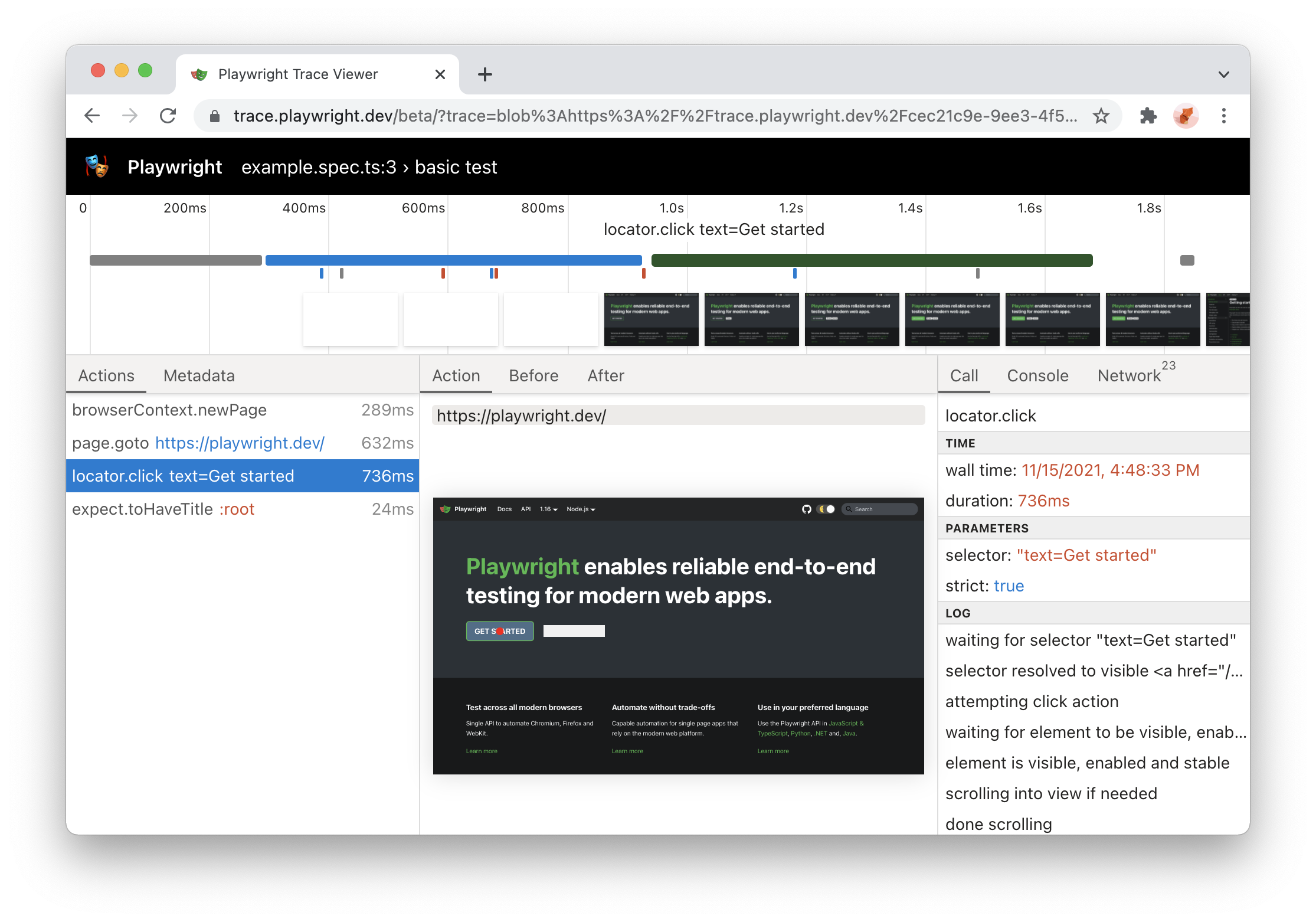
HTML Report Update
- HTML report now supports dynamic filtering
- Report is now a single static HTML file that could be sent by e-mail or as a slack attachment.

Ubuntu ARM64 support + more
-
Playwright now supports Ubuntu 20.04 ARM64. You can now run Playwright tests inside Docker on Apple M1 and on Raspberry Pi.
-
You can now use Playwright to install stable version of Edge on Linux:
pwsh bin/Debug/netX/playwright.ps1 install msedge
New APIs
Version 1.16
🎭 Playwright Library
Locator.WaitForAsync
Wait for a locator to resolve to a single element with a given state. Defaults to the state: 'visible'.
var orderSent = page.Locator("#order-sent");orderSent.WaitForAsync();
Read more about Locator.WaitForAsync() .
🎭 Playwright Trace Viewer
- run trace viewer with
pwsh bin/Debug/netX/playwright.ps1 show-traceand drop trace files to the trace viewer PWA - better visual attribution of action targets
Read more about Trace Viewer .
Browser Versions
- Chromium 97.0.4666.0
- Mozilla Firefox 93.0
- WebKit 15.4
This version of Playwright was also tested against the following stable channels:
- Google Chrome 94
- Microsoft Edge 94
Version 1.15
🖱️ Mouse Wheel
By using Mouse.WheelAsync() you are now able to scroll vertically or horizontally.
📜 New Headers API
Previously it was not possible to get multiple header values of a response. This is now possible and additional helper functions are available:
🌈 Forced-Colors emulation
Its now possible to emulate the forced-colors CSS media feature by passing it in the Browser.NewContextAsync()
or calling Page.EmulateMediaAsync()
.
New APIs
- Page.RouteAsync()
accepts new
timesoption to specify how many times this route should be matched. - Page.SetCheckedAsync() and Locator.SetCheckedAsync() were introduced to set the checked state of a checkbox.
- Request.SizesAsync() Returns resource size information for given http request.
- Tracing.StartChunkAsync()
- Start a new trace chunk.
- Tracing.StopChunkAsync()
- Stops a new trace chunk.
Important ⚠
- ⬆ .NET Core Apps 2.1 are no longer supported for our CLI tooling. As of August 31st, 2021, .NET Core 2.1 is no longer supported and will not receive any security updates. We've decided to move the CLI forward and require .NET Core 3.1 as a minimum.
Browser Versions
- Chromium 96.0.4641.0
- Mozilla Firefox 92.0
- WebKit 15.0
Version 1.14
⚡️ New "strict" mode[](https://playwright.dev/dotnet/docs/release-notes#%EF%B8%8F-new-strict-mode "Direct link to ⚡️ New "strict" mode")
Selector ambiguity is a common problem in automation testing. "strict" mode ensures that your selector points to a single element and throws otherwise.
Set setStrict(true) in your action calls to opt in.
// This will throw if you have more than one button!await page.Locator("button", new() { Strict = true });
📍 New Locators API
Locator represents a view to the element(s) on the page. It captures the logic sufficient to retrieve the element at any given moment.
The difference between the Locator and ElementHandle is that the latter points to a particular element, while Locator captures the logic of how to retrieve that element.
Also, locators are "strict" by default!
var locator = page.Locator("button");await locator.ClickAsync();
Learn more in the documentation .
🧩 Experimental React
React and Vue selectors allow selecting elements by its component name and/or property values. The syntax is very similar to attribute selectors and supports all attribute selector operators.
await page.Locator("_react=SubmitButton[enabled=true]").ClickAsync();await page.Locator("_vue=submit-button[enabled=true]").ClickAsync();
Learn more in the react selectors documentation and the vue selectors documentation .
✨ New nth
-
nthselector engine is equivalent to the:nth-matchpseudo class, but could be combined with other selector engines. -
visibleselector engine is equivalent to the:visiblepseudo class, but could be combined with other selector engines.// select the first button among all buttonsawait button.ClickAsync("button >> nth=0");// or if you are using locators, you can use First, Nth() and Lastawait page.Locator("button").First.ClickAsync();// click a visible buttonawait button.ClickAsync("button >> visible=true");
Browser Versions
- Chromium 94.0.4595.0
- Mozilla Firefox 91.0
- WebKit 15.0
Version 1.13
Playwright
- 🖖 Programmatic drag-and-drop support via the Page.DragAndDropAsync() API.
- 🔎 Enhanced HAR with body sizes for requests and responses. Use via
recordHaroption in Browser.NewContextAsync() .
Tools
- Playwright Trace Viewer now shows parameters, returned values and
console.log()calls.
New and Overhauled Guides
Browser Versions
- Chromium 93.0.4576.0
- Mozilla Firefox 90.0
- WebKit 14.2
New Playwright APIs
-
new
baseURLoption in Browser.NewContextAsync() and Browser.NewPageAsync() -
Response.SecurityDetailsAsync() and Response.ServerAddrAsync()
-
Page.InputValueAsync() , Frame.InputValueAsync() and ElementHandle.InputValueAsync()
-
new
forceoption in Page.FillAsync() , Frame.FillAsync() , and ElementHandle.FillAsync() -
new
forceoption in Page.SelectOptionAsync() , Frame.SelectOptionAsync() , and ElementHandle.SelectOptionAsync()
Version 1.12
Highlights
- Playwright for .NET v1.12 is now stable!
- Ships with the codegen and trace viewer tools out-of-the-box
Browser Versions
- Chromium 93.0.4530.0
- Mozilla Firefox 89.0
- WebKit 14.2
This version of Playwright was also tested against the following stable channels:
-
Google Chrome 91
-
Microsoft Edge 91